
|
 |
At Animation Obsessive, we explore stories from the wide, wide world of animation — including stories rarely told. Expect human craft and buried treasure, every Sunday (for everyone) and Thursday (for paying subscribers).


 |
Welcome! This is another Sunday edition of the Animation Obsessive newsletter, and this is the lineup:
1. How Winnie-the-Pooh was reimagined in the Soviet Union.
2. Animation newsbits.
Now, let’s go!
1. Reinventing Pooh
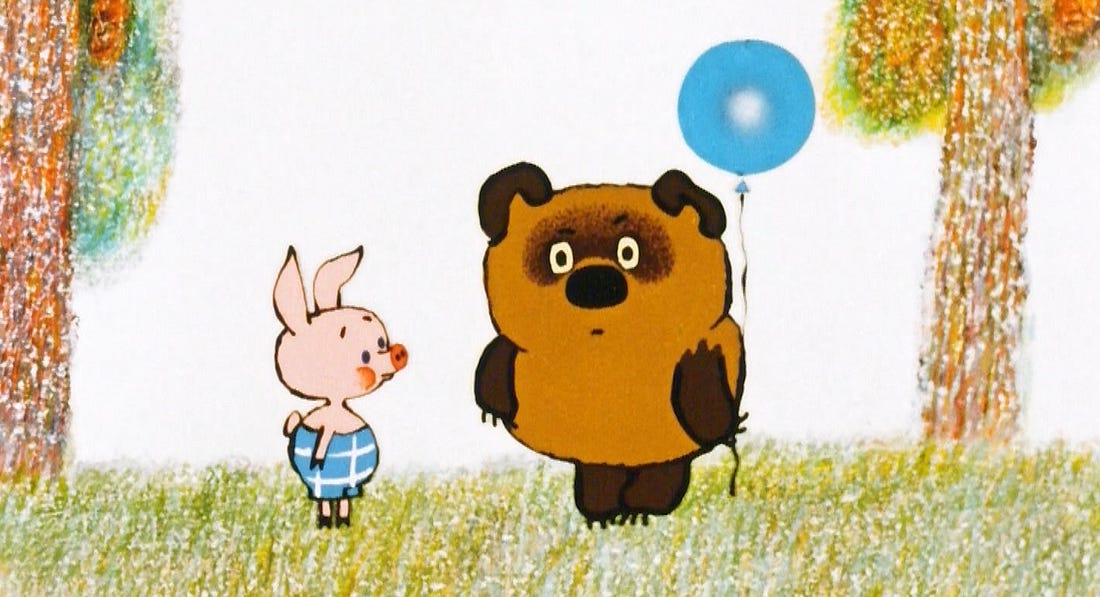
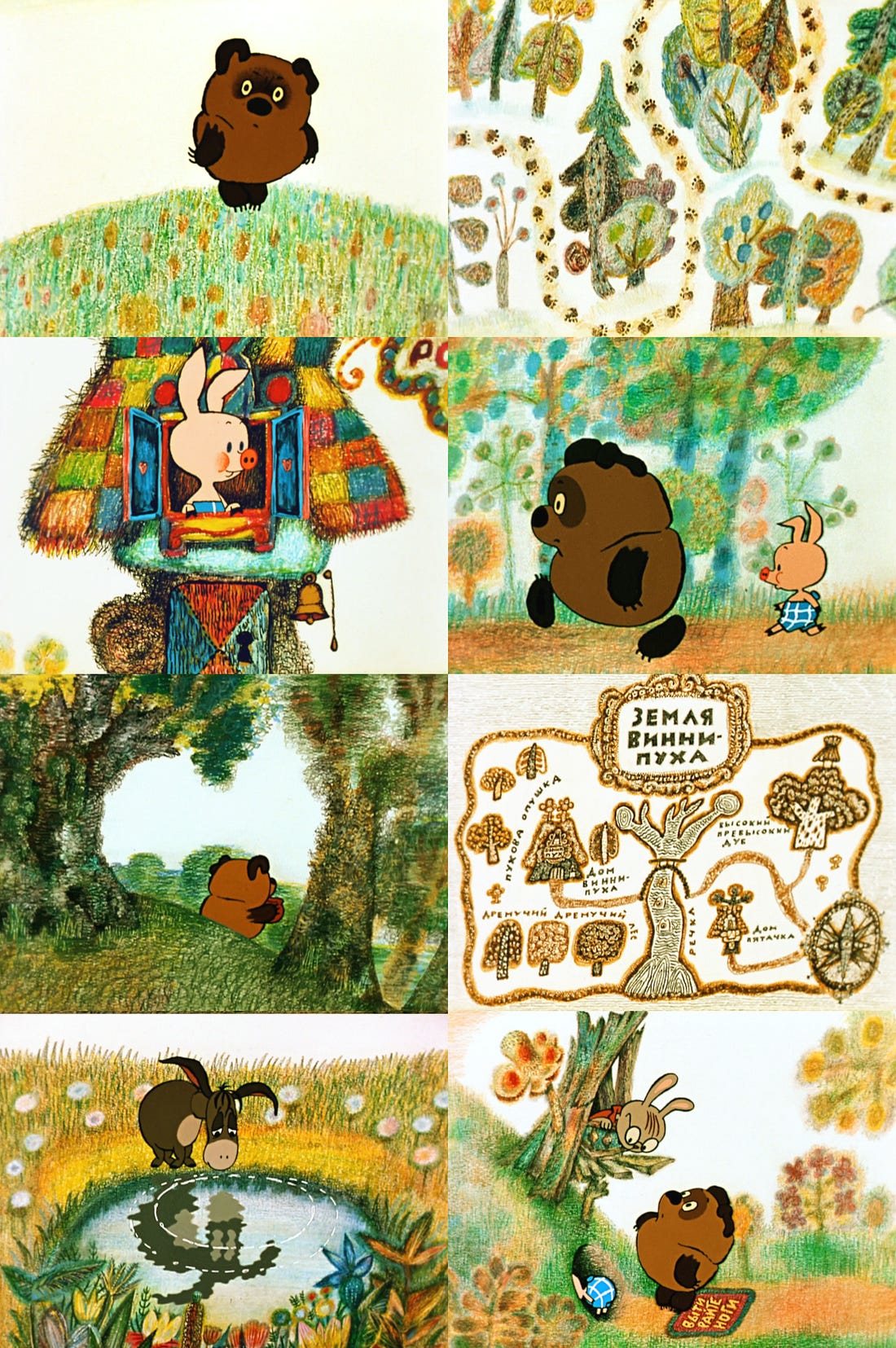
During the ‘60s and ‘70s, in the USSR, there emerged a series of films based on Winnie-the-Pooh. It’s a treasure. Each entry handles Milne’s stories precisely, and with incredible charm and humor. They all remain hugely popular today.
And at the films’ core is their take on Pooh himself. He isn’t quite Milne’s Pooh, or Disney’s. Many hands at Moscow’s Soyuzmultfilm made him what he is.
A precious book from recent years is Legends of the Soyuzmultfilm Studio. Historian Sergey Kapkov wrote it — gathering some 400 pages of interviews with people from the studio’s classic era. Winnie-the-Pooh veterans were among them. Director Fyodor Khitruk, animator Violetta Kolesnikova and designers Eduard Nazarov and Vladimir Zuikov all spoke to him about the mysteries of Pooh.
The idea to animate these stories had been on Khitruk’s mind since the ‘40s. It was only in the ‘60s, though, that he encountered the Russian edition of Winnie-the-Pooh. By then, Khitruk was the USSR’s top animation director — his Story of a Crime (1962) helped to bring about a stylistic revolution. With the Winnie-the-Pooh translation in hand, he and his circle of artists began their struggle to bring the character to the screen, without having watched the Disney adaptation.¹
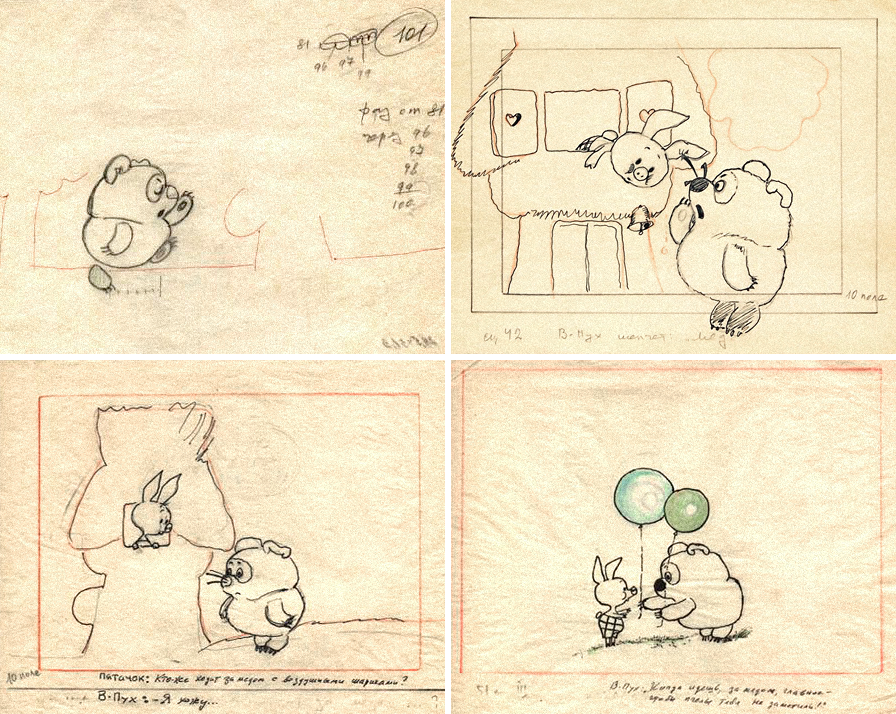
Their goal was to make “an absolutely new bear,” unlike any animated before.² Khitruk didn’t want to copy the original illustrations, either. In Legends of the Soyuzmultfilm Studio, we hear from Eduard Nazarov about Vladimir Zuikov’s initial design sketches:
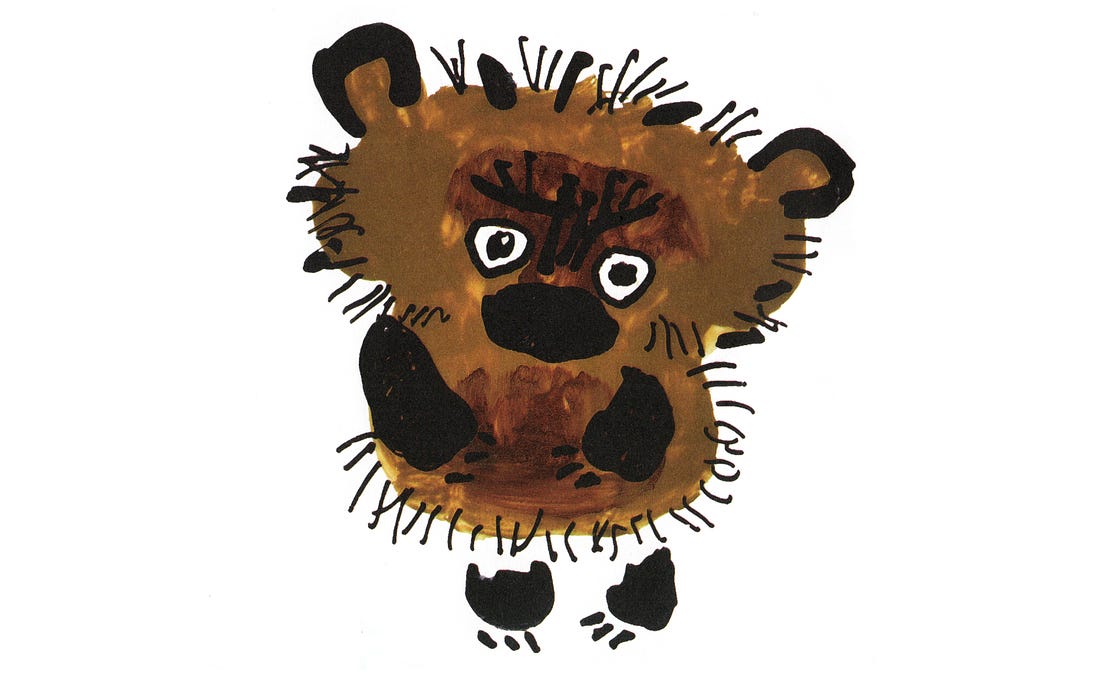
At first, Volodya Zuikov brought a completely unimaginable character. It was not a teddy bear, but a crazed dandelion, a creature of ambiguous form: woolly, bristly, as if made from an old mop that had lost its shape. Its ears — like someone had chewed on them but hadn’t had time to eat one of them. A nose somewhere on its cheek, asymmetrical eyes, and everything was pointing in different directions. But there was something in it! And Khitruk clutched his head: “Hell, what have you come up with?!”³
 |
Zuikov gets his say in Kapkov’s book, too. At the time of Winnie-the-Pooh, he was somewhat new to animation — he’d just worked with Khitruk on the design for a movie title sequence and for the classic Film, Film, Film (1968). Khitruk took to him in that period. “I felt that this artist was born for animation,” the director said.⁴
As the team revised his wild Pooh design, Zuikov played an essential role. To quote his interview in the book:
Edik Nazarov always laughed, saying that I’d drawn a dandelion. But that was the first version. Then I remembered that, in my childhood, I had a scruffy teddy bear with a flattened ear and one eye, because I had horsed around with it a lot. No neck; the head was simply flat against the body. That’s how I drew it. And Khitruk asked, “Where’s the neck?” I answered, “What for?” And then we came up with the idea that he wouldn’t have a neck and would turn with his entire body.
It was a process: not much about the character came easily. Many members of the team tried their hand at Pooh’s design. In fact, it’s hard to credit his final look to a single artist — the flattened ear was Zuikov’s, but Nazarov contributed the uneven line weight to Pooh’s back.
As Zuikov wrote elsewhere, “No one can imagine how much trouble had to be endured at the beginning of work on Winnie-the-Pooh.”
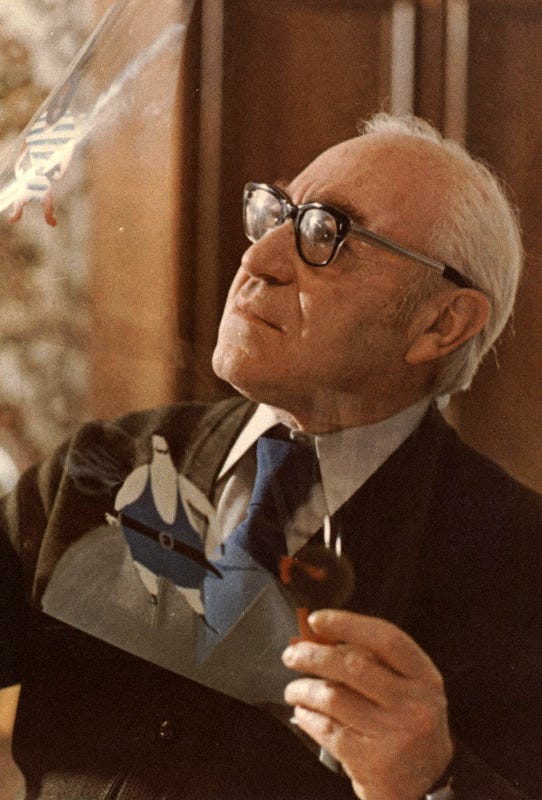 |
The problems went further than design. Khitruk had long been nervous to adapt these stories — “every line … was dear to me,” he wrote. Making a short film out of Milne’s books would mean careful condensing, plus visualizing the spirit of the text.
Khitruk needed to “translate all the inexpressible charm of the language” into images, as he put it. The books rely on subtleties of wording and rhythm for their effect. He cited the passage, “Rabbit and Piglet were sitting outside Pooh’s front door listening to Rabbit, and Pooh was sitting with them.” How do you draw that sentence?
As a director, Khitruk favored just-so timing, editing and movement. You see them in The Story of a Crime and in the films that followed. This sensibility allowed him to put humor and interest into a scene through a tiny pause, or a slight change in delivery, or a gesture that’s a little awkward. He had a mastery of tone — and he used it to capture Pooh’s character and the magic of Milne’s world.
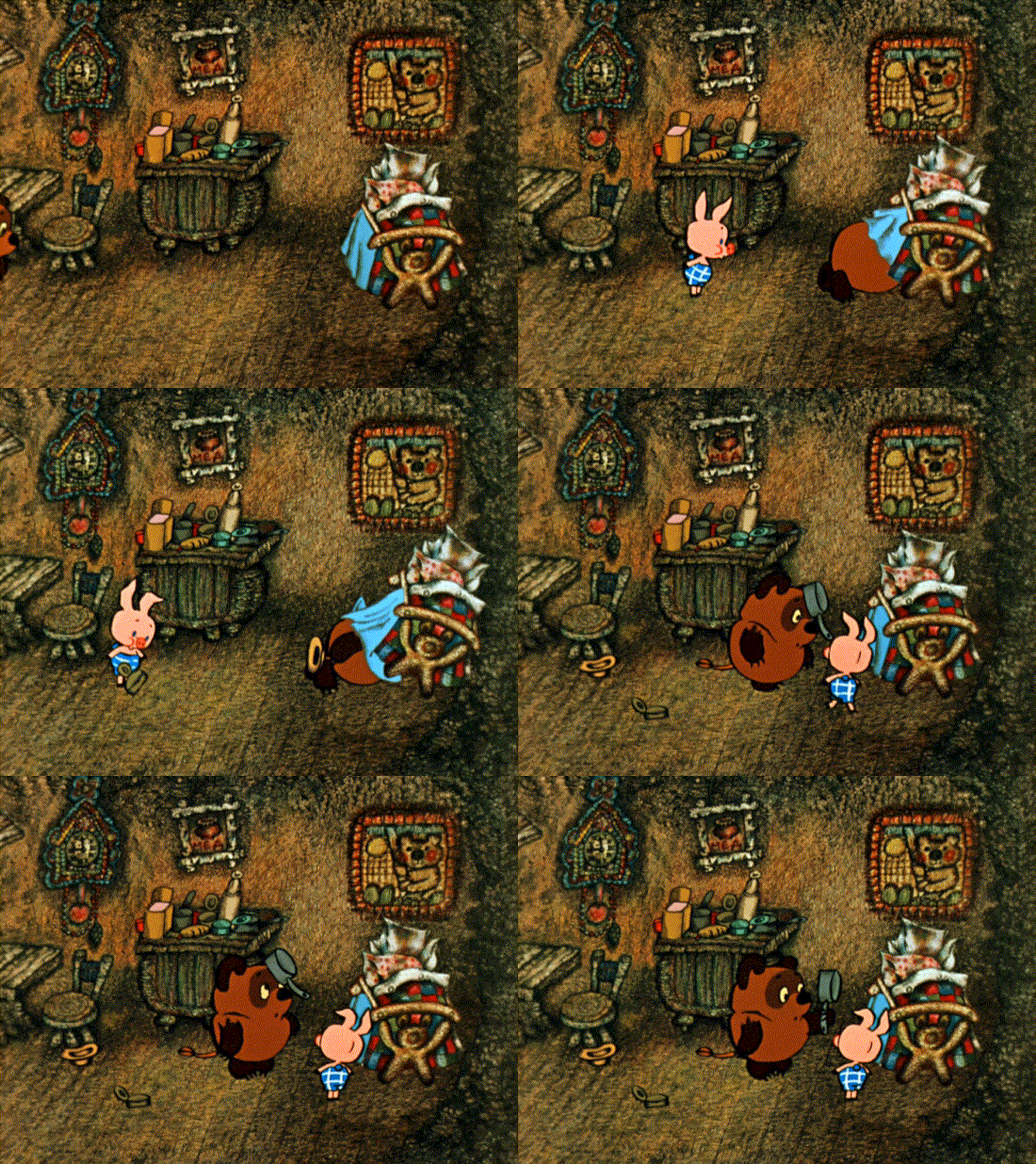
Yuri Norstein, a pupil of Khitruk’s, highlighted the moment when Pooh falls from a great height in the first Winnie-the-Pooh film. He’s stunned after he lands — he freezes in a single pose as Piglet worries over him. But, while Pooh doesn’t move, the scene never deflates. It uses timing and rhythm to get subtle humor, and “inexpressible charm.”
“Khitruk knows how to hold the composition for the necessary time: it doesn’t hang in space; it is taut,” Norstein wrote.⁵
 |
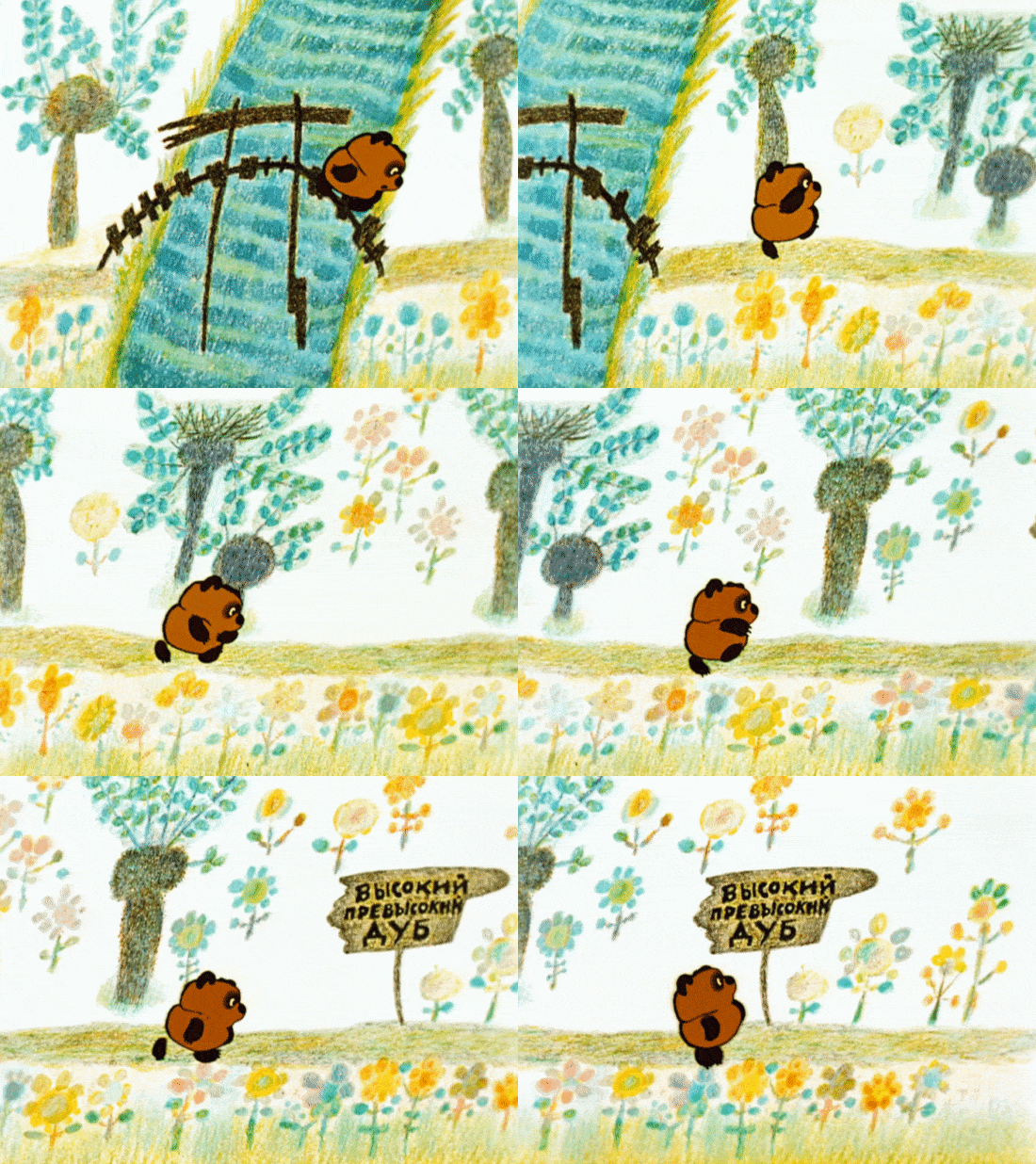 |
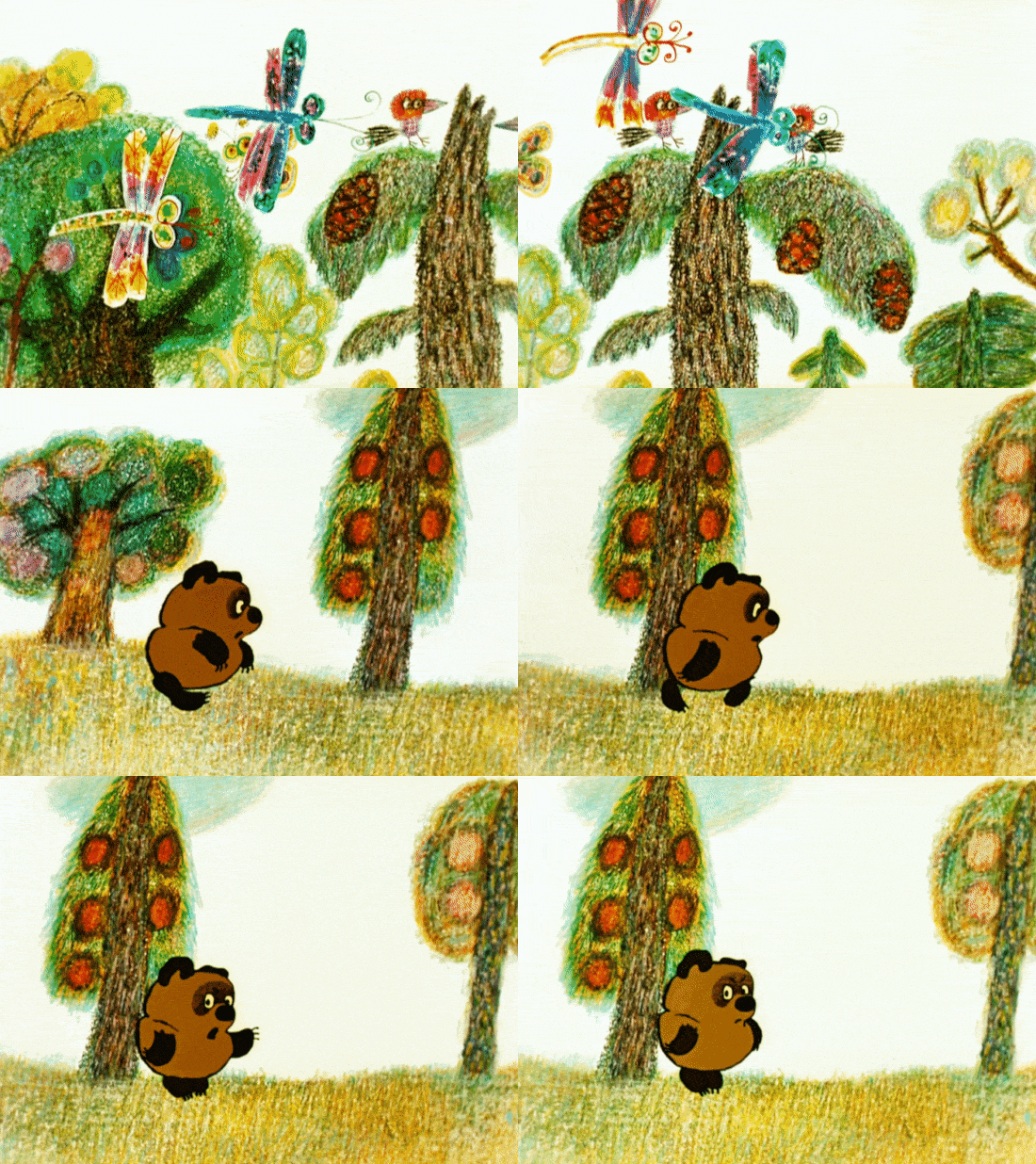
Still, again, much of the thought behind Pooh’s mannerisms and acting wasn’t Khitruk’s alone. In Legends of the Soyuzmultfilm Studio, we learn about the origin of Pooh’s famous walk from animator Violetta Kolesnikova:
I came to the group a month later because I was finishing work on a previous film. The group was in mourning — the character’s walk wouldn’t turn out. ... I suffered, followed all the details, caught the rhythm of the walk, how the paws should work... and Winnie-the-Pooh walked.
The final effect she got was unique. In the films, Pooh travels on floating feet: he has no legs. But breaking the laws of physics in this way gave his walk an infectious bounce that’s memorable after one viewing.
Pooh’s design was odd enough to demand new solutions from the animators. He’s built with thick, inflexible shapes and can’t move normally. Nazarov said that the character was “made up entirely of impossibilities,” in the sense that every part of him resisted animation. “But this is where the interest emerges,” he added.
The effort to move this character led to discoveries — some of which were accidents. A talented animator, Maria Motruk (Khitruk’s wife), made a mistake while in-betweening Pooh’s walk. “And the bear on the screen suddenly waved his arms senselessly. We laughed so much!” said Kolesnikova. After the team persuaded Khitruk to keep it, Pooh’s poor coordination became a signature of his character.
 |
 |
For Khitruk, Pooh was fundamentally “a philosopher, a dreamer.” He’s a deep thinker with sawdust in his head: naive, but completely serious. He bumbles along according to his personal nonsense logic. And that’s, really, the engine of the Soviet Winnie-the-Pooh films. Khitruk made a point of removing Christopher Robin — and with him any higher authority who could call into question Pooh’s philosophy of serious nonsense.⁶
Khitruk liked to credit one person above all for crystallizing this spirit of the character: Pooh’s voice actor. As Khitruk said, “[T]he success of Winnie-the-Pooh depended to a large extent on the work of Yevgeny Leonov.”
Casting the films was tough — Leonov was one of many actors who auditioned. At first, Khitruk wasn’t sure that even he would fit. “Every day I became more and more convinced that Leonov’s voice was absolutely... unsuitable for Pooh,” he said. Then George Martynuk, the sound editor, pitched the idea of speeding up the recording. And it was perfect.
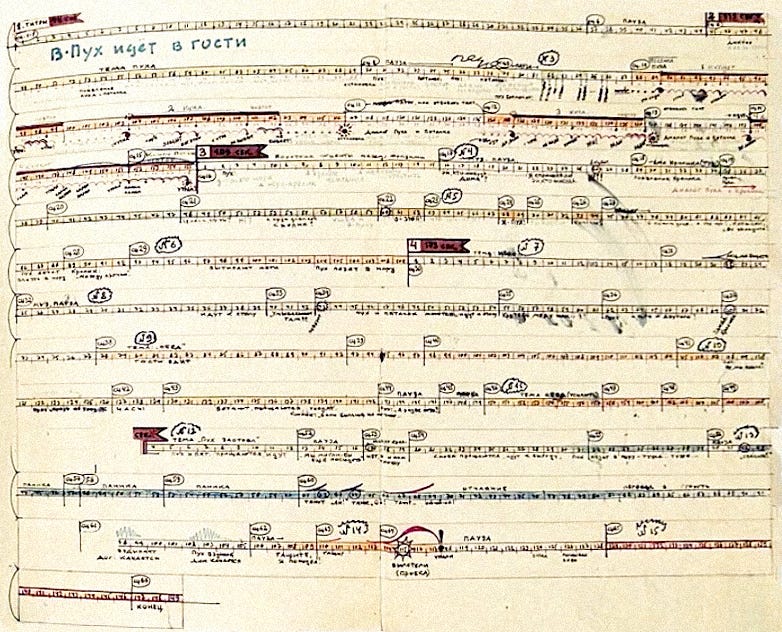
Khitruk used Leonov’s performance during the sessions as a reference for the animation. He once wrote:
[Leonov] didn’t simply recite the text written in the script into the microphone, but somehow immediately and precisely picked up the character of the hero. Here he stood before the microphone, froze for a moment, adopted some kind of pose, his gaze became pensive — and we felt the state we had been seeking for so long; this is exactly how our hero should be. Leonov managed at once and unmistakably to find the image of this eccentric dreamer.
I called to the animators: look, draw.
 |
 |
Some on the team, though, have mentioned a different main source for Pooh. In his awkwardness and daydreaming, even in his gestures, they saw Khitruk. “You just have to look at how he turns around, how he moves his hands and how he puts his hands to his head, as if they were paws,” said Eduard Nazarov.⁷
Khitruk admitted to Kapkov that the Pooh-like director in Film, Film, Film was based on his own experiences. Yet he implied that Pooh’s similarities to him were, if anything, a coincidence.
That said, he didn’t need to add those similarities for them to be intentional. The animators for the Winnie-the-Pooh films were watching the people around them. Violetta Kolesnikova wore oversized glasses at the time and constantly pushed them back up her nose. Another animator gave that tic to Rabbit. It’s easy to imagine the same happening with Khitruk and Pooh.
Which reinforces a point. Soyuzmultfilm’s Pooh didn’t belong to any one person who contributed to him. Khitruk guided the process, but even he didn’t make every decision that created the character. Pooh’s depth came from teamwork — including the team’s collaboration with Boris Zakhoder, who wrote the Russian edition of the books and helped with the films.
That teamwork led to a very, very special character. When Khitruk later visited the Disney studio, his Winnie-the-Pooh won praise from Wolfgang Reitherman, who directed several of Disney’s Pooh films. Khitruk loved Disney’s classic characters — but he and his whole team had delivered one of their own.
This is a revised reprint of an article that first ran in our newsletter, behind the paywall, on April 24, 2025.
2. Newsbits
We lost Yuji Ohno (84), longtime composer for Lupin the 3rd, including The Castle of Cagliostro and The First.
In Japan, Katsuhiro Otomo of Akira fame is reportedly working on a film at his new animation studio, Oval Gear.
In Cuba, Animaluz Academy continued its animation workshops for children this week, despite another loss of power. Meanwhile, the head of the ICAIC spoke about efforts to boost independent filmmakers in the country, including animators. (Cuban indie productions were made legal in 2019.)
The rights to Matt Braly’s canceled Hollywood movie Afterworld were picked up by an animation company in Thailand: The Monk Studio.
There’s a major new documentary on YouTube about the early history of computer animation in America. It comes from the creator of Drawing for Nothing, and a lot of research (and interviews) went into it.
Keanu Reeves boarded the Japanese feature Hidari as the voice of the lead character. “He’s not just lending his voice to Hidari,” added director Masashi Kawamura, “he’s helping us shape and expand this world.”
The Russian stop-motion film Hoffmaniada is getting a Blu-ray release stateside through Deaf Crocodile. (We have a special feature on this one.)
On that note: Bulgakov, the latest by the director of Hoffmaniada, landed on YouTube. No official subtitles yet, but it’s one of the more acclaimed Russian shorts from the past few years.
Among the recent CalArts student films in America, a definite highlight is the one by Abby Mills — which has a long title and a sharp point to make.
Production of Newplast, the modeling clay behind Aardman’s films, ended in 2023. Now, Britain’s Animation Supplies seeks to replace it with a new material called Chroma Clay.
A few weeks ago, Shaun Tan’s Tales from Outer Suburbia picked up a big award in Australia. In the States, it streams for free on BYUtv.
The Stuttgart festival in Germany handed a special mention to Amarelo Banana (trailer) — a very strange, very fascinating film we enjoyed last year. Shanghai Animation’s A Story About Fire was also recognized. See the full list.
Last of all: we wrote about the animated Animal Farm (1954), and the unusual circumstances of its creation.
Until next time!
See this Khitruk interview with Fakty ta Komentari and his book Profession – Animator (volume one), both used throughout.
See Profession – Animator (volume two), another useful source.
This block quote comes from Nazarov’s interview in Legends of the Soyuzmultfilm Studio. We relied on it (and on the ones with Khitruk, Zuikov and Kolesnikova) throughout.
See Cinema Art (September 1977).
From The Century of Fyodor Khitruk (Век Фёдора Хитрука).
Khitruk wrote about Pooh-as-philosopher here and in The Wisdom of Fiction (1983), used several times. See also Zuikov’s interview with Novaya Gazeta.
Nazarov said this in the documentary The Spirit of Genius.
Thank you so much for reading! If you’ve enjoyed today’s issue, have you considered forwarding it to a friend?
 |
| ||||||||||


